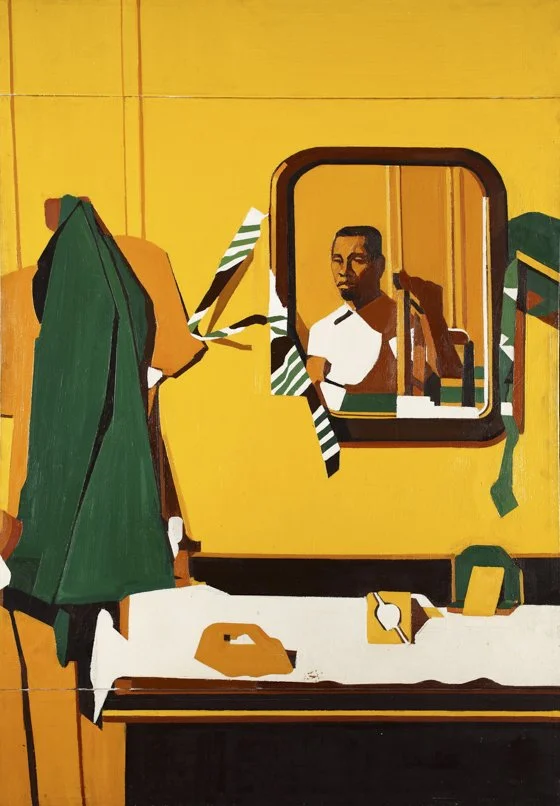
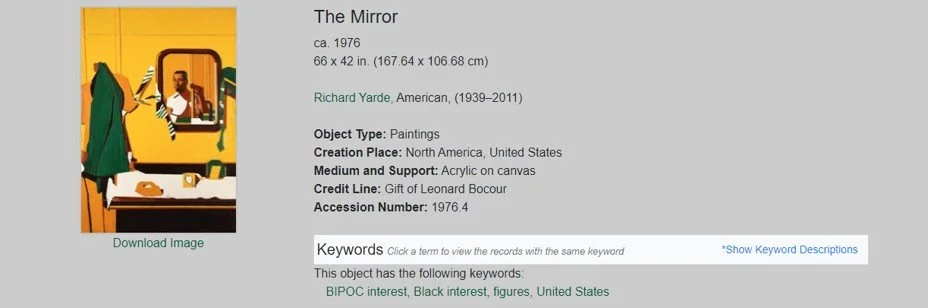
Screenshot of BUAM online database
Towards inclusive metadata: BUAM Statement of Purpose
Revised Spring 2023
Claire L. Kovacs, BUAM Curator of Collections and Exhibitions
Eliana Ellerton, BUAM Intern - Collections Management/’23, History
GLAM (Galleries, Libraries, Archives, and Museum)’s metadata and resource description has traditionally encouraged a “neutral” vocabulary and narrative style that too often reinforces the societal power structures that conform to expectations of the hegemonic default (white, male, heterosexual, gender-normative, upper-middle class, global north – just to name a few). This BUAM-specific project aims to begin the process of repair and excavation through transparency, iteration, collaboration, and consultation. As Jarrett M. Drake writes:
The truly transformative principle that is needed for archival practice and archival description cannot come from one person or from one invite-only forum, but such a principle necessarily must develop organically, slowly, and anti-oppressively with a radical cross-section of academic, disciplinary, racial, ethnic, gender, cultural and class backgrounds represented.[1]
This project will necessarily be slow and measured and will eventually include all points of metadata creation: processing, review, remediation, and reprocessing to ensure that it “‘accurately, appropriately, and respectfully’ represents marginalized and underrepresented persons and contexts through descriptive metadata practices.”[2] It will also strive to, as described by the Archives for Black Lives in Philadelphia project, "[b]e mindful that terminology changes over time, so description will be an iterative process."[3]
As we look to reframe the process of metadata creation, queer theory provides a useful framework because it challenges the idea that metadata can ever be corrected once and for all. It pushes against the idea of fixed categories, arguing that this framework of metadata creation “…froze identities in time and universalized them, erasing the real differences that accompany [identity] on the scales of time and place…Rather than taking these identities as stable and fixed, queer theory sees these identities as shifting and contextual.”[4] Queer theory instead encourages us to be “ethically and politically engaged on behalf of [those with] marginal knowledge formations and identities who quite reasonably expect to be able to locate themselves in the [collections].”[5]
Community-based collaboration and consultation will also inform our process. As Terry Cook points out:
Community-based archiving involves…a shift in core principles, from exclusive custodianship and ownership of archives to shared stewardship and collaboration; from dominant-culture language, terminology, and definitions to sensitivity to the ‘other’ and as keen an awareness of the emotional, religious, symbolic, and cultural values that records have to their communities as of their administrative and juridical significance. These changes challenge us to stop seeing community archiving as something local, amateur, and of limited value to the broader society, and to start recognizing that community-based archiving is often a long-standing and well-established praxis from which we can learn much.[6]
Without consultation and collaboration with communities, the process might inadvertently introduce additional issues to the metadata process. As A. Matienzo points out, “Without thought, without conversation, and without vulnerability on the part of those of you with good intentions, our process of correction can simultaneously introduce and spackle over its own violence.”[7] We can inadvertently share information that is private, use language that is inappropriate and/or inaccessible, or gloss over parts of identity that are important to the maker(s) due to the biases that the creator of metadata brings to the table. It is important for us to: examine our own privilege, positionality, and biases; think about the language we use; consider how we use language; and decentralize the process of creating metadata.
Acknowledgments:
We would like to thank the following Binghamton departments and offices for their input on drafts of this project: Q Center, Multicultural Resources Center, Services for Students with Disabilities, and the Binghamton Library Special Collections and University Archive.
Citations:
[1] Jarrett M. Drake, “RadTech Meets RadArch: Towards A New Principle for Archives and Archival Description,” On Archivy (blog), April 7, 2016, https://medium.com/on-archivy/radtech-meets-radarch-towards-a-new-principle-for-archives-and-archival-description-568f133e4325.
[2] Annie Tang et al., “Toward Culturally Competent Archival (Re)Description of Marginalized Histories,” n.d., 56. Also cites “Decolonizing Description: Changing... | ERA,” accessed October 6, 2022, https://era.library.ualberta.ca/items/91ab16fe-5a03-4c10-b051-29c7caf0b57f.
[3] Archives for Black Lives in Philadelphia, “Archives for Black Lives in Philly,” June 16, 2022, https://github.com/a4blip/A4BLiP.
[4] Emily Drabinski, “Queering the Catalog: Queer Theory and the Politics of Correction,” The Library Quarterly: Information, Community, Policy 83, no. 2 (2013): 94–111, https://doi.org/10.1086/669547. In the original quote, Drabinski uses “same-sex sexuality,” but this idea can be applied to interlocking identities as a whole.
[5] Drabinski. In the original quote, Drabinski used “library,” but this can be applied to GLAM collections as a whole.
[6] Terry Cook, “Evidence, Memory, Identity, and Community: Four Shifting Archival Paradigms,” Archival Science 13, no. 2–3 (June 2013): 95–120, https://doi.org/10.1007/s10502-012-9180-7.
[7] M. A. Matienzo, “To Hell With Good Intentions: Linked Data, Community, and the Power to Name,” 2015, https://matienzo.org/2016/to-hell-with-good-intentions/.
Bibliography
Adler, Melissa. “The Case for Taxonomic Reparations.” KO KNOWLEDGE ORGANIZATION 43, no. 8 (December 14, 2016): 630–40. https://doi.org/10.5771/0943-7444-2016-8-630.
Alpert-Abrams, Hannah, David A. Bliss, and Itza Carbajal. “Post-Custodial Archiving for the Collective Good: Examining Neoliberalism in US-Latin American Archival Partnerships.” Journal of Critical Library and Information Studies 2, no. 1 (March 3, 2019). https://doi.org/10.24242/jclis.v2i1.87.
Archives for Black Lives in Philadelphia. “Archives for Black Lives in Philly,” June 16, 2022. https://github.com/a4blip/A4BLiP.
Center for Story-based Strategy. “Anti-Oppression Principles.” Accessed August 12, 2022. https://www.storybasedstrategy.org/anti-oppression-principles.
“Archives Have the Power to Boost Marginalized Voices | Dominique Luster | TEDxPittsburgh - YouTube.” Accessed August 11, 2022. https://www.youtube.com/watch?v=XsNPlBBi1IE.
Issues & Advocacy. “#ArchivesSoWhite Intro & Bibliography,” April 18, 2016. https://issuesandadvocacy.wordpress.com/2016/04/18/archivessowhite-intro-bibliography/.
Baucom, Erin. “An Exploration into Archival Descriptions of LGBTQ Materials.” The American Archivist 81, no. 1 (March 2018): 65–83. https://doi.org/10.17723/0360-9081-81.1.65.
Beckman, Liz, Lynn Eaton, Yoko Ferguson, David Heilbrun, Rachel Lavender, Tricia Mackenzie, and Dorothee Schubel. “Ethical and Anti-Oppressive Metadata: A Collaboration Between Catalogers and Archivists at George Mason University Libraries,” 2022, 12.
Carbajal, Itza A. “Historical Metadata Debt: Confronting Colonial and Racist Legacies Through a Post-Custodial Metadata Praxis.” Across the Disciplines 18, no. 1–2 (2021): 91–107. https://doi.org/10.37514/ATD-J.2021.18.1-2.08.
Caswell, Michelle. “Seeing Yourself in History: Community Archives and the Fight Against Symbolic Annihilation.” The Public Historian 36, no. 4 (2014): 26–37. https://doi.org/10.1525/tph.2014.36.4.26.
———. “Teaching to Dismantle White Supremacy in Archives.” The Library Quarterly 87, no. 3 (July 2017): 222–35. https://doi.org/10.1086/692299.
———. “Toward a Survivor-Centered Approach to Records Documenting Human Rights Abuse: Lessons from Community Archives.” Archival Science 14, no. 3–4 (October 2014): 307–22. https://doi.org/10.1007/s10502-014-9220-6.
Caswell, Michelle, and Marika Cifor. “From Human Rights to Feminist Ethics: Radical Empathy in the Archives.” Archivaria 81, no. 1 (2016): 23–43.
Christen, Kimberly. “Opening Archives: Respectful Repatriation.” The American Archivist 74, no. 1 (2011): 185–210.
Clemens, Alison. “Yale University Library Research Guides: Reparative Archival Description Working Group: Home.” Accessed August 12, 2022. https://guides.library.yale.edu/c.php?g=1140330&p=8319098.
Cook, Terry. “Evidence, Memory, Identity, and Community: Four Shifting Archival Paradigms.” Archival Science 13, no. 2–3 (June 2013): 95–120. https://doi.org/10.1007/s10502-012-9180-7.
“Decolonizing Description: Changing... | ERA.” Accessed October 6, 2022. https://era.library.ualberta.ca/items/91ab16fe-5a03-4c10-b051-29c7caf0b57f.
Douglas, Jennifer. “Toward More Honest Description1.” The American Archivist 79, no. 1 (June 1, 2016): 26–55. https://doi.org/10.17723/0360-9081.79.1.26.
Drabinski, Emily. “Queering the Catalog: Queer Theory and the Politics of Correction.” The Library Quarterly: Information, Community, Policy 83, no. 2 (2013): 94–111. https://doi.org/10.1086/669547.
Drake, Jarrett M. “Expanding #ArchivesForBlackLives to Traditional Archival Repositories.” On Archivy (blog), June 27, 2016. https://medium.com/on-archivy/expanding-archivesforblacklives-to-traditional-archival-repositories-b88641e2daf6.
———. “RadTech Meets RadArch: Towards A New Principle for Archives and Archival Description.” On Archivy (blog), April 7, 2016. https://medium.com/on-archivy/radtech-meets-radarch-towards-a-new-principle-for-archives-and-archival-description-568f133e4325.
Dunbar, Anthony W. “Introducing Critical Race Theory to Archival Discourse: Getting the Conversation Started.” Archival Science 6, no. 1 (March 1, 2006): 109–29. https://doi.org/10.1007/s10502-006-9022-6.
DigitalNC. “Equitable Metadata Practices Related to Gender, Race, and Culture.” Accessed August 5, 2022. https://www.digitalnc.org/partners/describing-your-materials/equitable-metadata/.
Flinn, Andrew, and Ben Alexander. “‘Humanizing an Inevitability Political Craft’: Introduction to the Special Issue on Archiving Activism and Activist Archiving.” Archival Science 15 (October 20, 2015). https://doi.org/10.1007/s10502-015-9260-6.
“Guidelines for Collaboration.” Accessed August 5, 2022. https://guidelinesforcollaboration.info/.
“Homosaurus Vocabulary Site.” Accessed August 5, 2022. https://homosaurus.org/.
Hughes-Watkins, Lae’l. “Moving Toward a Reparative Archive: A Roadmap for a Holistic Approach to Disrupting Homogenous Histories in Academic Repositories and Creating Inclusive Spaces for Marginalized Voices.” Journal of Contemporary Archival Studies 5, no. 1 (May 16, 2018). https://elischolar.library.yale.edu/jcas/vol5/iss1/6.
Kelleher, Christian. “Archives Without Archives: (Re)Locating and (Re)Defining the Archive Through Post-Custodial Praxis.” Journal of Critical Library and Information Studies 1, no. 2 (July 7, 2017). https://doi.org/10.24242/jclis.v1i2.29.
Larade, Sharon P., and Johanne M. Pelletier. “Mediating in a Neutral Environment: Gender-Inclusive or Neutral Language in Archival Descriptions.” Archivaria, 1993. https://archivaria.ca/index.php/archivaria/article/view/11889.
Light, Michelle, and Tom Hyry. “Colophons and Annotations: New Directions for the Finding Aid.” The American Archivist 65, no. 2 (2002): 216–30.
Lindsey, N., Kuriger Suiter, G. & Hanselman, K. “Ethical Considerations of Including Gender Information in Open Knowledge Platforms.” KULA, 6(3) (2022), 1–15. https://doi.org/10.18357/kula.228
Littletree, Sandra, and Cheryl A. Metoyer. “Knowledge Organization from an Indigenous Perspective: The Mashantucket Pequot Thesaurus of American Indian Terminology Project.” Cataloging & Classification Quarterly 53, no. 5–6 (July 4, 2015): 640–57. https://doi.org/10.1080/01639374.2015.1010113.
Long, Kara, Santi Thompson, Sarah Potvin, and Monica Rivero. “The ‘Wicked Problem’ of Neutral Description: Toward a Documentation Approach to Metadata Standards.” Cataloging & Classification Quarterly 55, no. 3 (April 3, 2017): 107–28. https://doi.org/10.1080/01639374.2016.1278419.
Matienzo, M. A. “To Hell With Good Intentions: Linked Data, Community, and the Power to Name,” 2015. https://matienzo.org/2016/to-hell-with-good-intentions/.
Montenegro, María. “Subverting the Universality of Metadata Standards: The TK Labels as a Tool to Promote Indigenous Data Sovereignty.” Journal of Documentation 75, no. 4 (January 1, 2019): 731–49. https://doi.org/10.1108/JD-08-2018-0124.
DigitalNC. “Moving Forward With Equitable Metadata: Changing Exclusive Terminology.” Accessed August 5, 2022. https://www.digitalnc.org/blog/moving-forward-with-equitable-metadata-changing-exclusive-terminology/.
Norsworthy, Kent, and T.-Kay Sangwand. “From Custody to Collaboration: The Post-Custodial Archival Model at the University of Texas Libraries.” Texas Conference on Digital Libraries (TCDL), 2013, Austin, Texas, United States, March 21, 2013. https://tdl-ir.tdl.org/handle/2249.1/66973.
Olson, Hope A. “The Power to Name: Representation in Library Catalogs.” Signs 26, no. 3 (2001): 639–68.
Queer Metadata Collective. “Queer Metadata Collective.” Accessed August 5, 2022. https://queermetadatacollective.org/.
Radical Copyeditor. “Radical Copyeditor.” Accessed August 12, 2022. https://radicalcopyeditor.com/.
“Reparative_processing_MAC_2018_slides.” Accessed August 12, 2022. https://docs.google.com/presentation/d/1MhOXx5ZlVjb_8pfvvFquMqLsUUlOHFFMT4js5EP4qnA.
“Report of the PCC Ad Hoc Task Group on Gender in Name Authority Records,” n.d., 21.
“ResearchGate.” Accessed August 12, 2022. https://www.researchgate.net/publication/283452185_Humanizing_an_inevitability_political_craft_Introduction_to_the_special_issue_on_archiving_activism_and_activist_archiving/link/5716003708ae6177286cc917/download.
“Revised Report on Recording Gender in Personal Name Authority Records,” n.d., 10.
rosarioja. “Archivists Gather to Discuss Digital Archives, Anti-Racism, and Critical Metadata Practices.” NULab for Texts, Maps, and Networks, April 21, 2022. https://cssh.northeastern.edu/nulab/digital-archives-antiracism-and-metadata-practices/.
Sangwand, T.-Kay. “Preservation Is Political: Enacting Contributive Justice and Decolonizing Transnational Archival Collaborations.” KULA: Knowledge Creation, Dissemination, and Preservation Studies 2 (November 29, 2018): 10–10. https://doi.org/10.5334/kula.36.
saywhatnathan1. “Indigenous Referencing Prototype – Non-Indigenous Authored Works.” Archival Decolonist [-o-] (blog), May 7, 2020. https://archivaldecolonist.com/2020/05/07/indigenous-referencing-prototype-non-indigenous-authored-works/.
Schwartz, Joan M., and Terry Cook. “Archives, Records, and Power: The Making of Modern Memory.” Archival Science 2, no. 1–2 (March 2002): 1–19. https://doi.org/10.1007/BF02435628.
Tang, Annie, Dorothy Berry, Kelly Bolding, and Rachel E Winston. “Toward Culturally Competent Archival (Re)Description of Marginalized Histories,” n.d., 56.
“The Hubris of Neutrality in Archives | by Sam Winn | On Archivy | Medium.” Accessed August 11, 2022. https://medium.com/on-archivy/the-hubris-of-neutrality-in-archives-8df6b523fe9f.
“The Language of Disability.” Accessed August 11, 2022. https://www.acedisability.org.au/information-for-providers/language-disability.php.
MIMI ỌNỤỌHA. “The Library of Missing Datasets — MIMI ỌNỤỌHA.” Accessed August 11, 2022. https://mimionuoha.com/the-library-of-missing-datasets.
Trans Metadata Collective, Jasmine Burns, Michelle Cronquist, Jackson Huang, Devon Murphy, K.J. Rawson, Beck Schaefer, Jamie Simons, Brian M. Watson, and Adrian Williams. “Metadata Best Practices for Trans and Gender Diverse Resources.” Zenodo, June 22, 2022. https://doi.org/10.5281/zenodo.6686841.
Trans Metadata Collective. “Trans Metadata Collective.” Accessed August 5, 2022. https://transmetadatacollective.org/.
DigitalNC. “We Can Do Better: Making Our Metadata More Equitable.” Accessed August 11, 2022. https://www.digitalnc.org/blog/we-can-do-better-making-our-metadata-more-equitable/.
Wagner, T. L. “She Started Wearing Men’s Clothes and Acting More Masculine”: Queering Historical Knowledge, Gendered Identity Making, and Trans Potentialities in Visual Information. The International Journal of Information, Diversity, & Inclusion, 5(4) (2022), 21–42. https://www.jstor.org/stable/48641978
Williams, Stacie M., and Jarrett Drake. “Power to the People: Documenting Police Violence in Cleveland.” Journal of Critical Library and Information Studies 1, no. 2 (April 23, 2017). https://doi.org/10.24242/jclis.v1i2.33.